
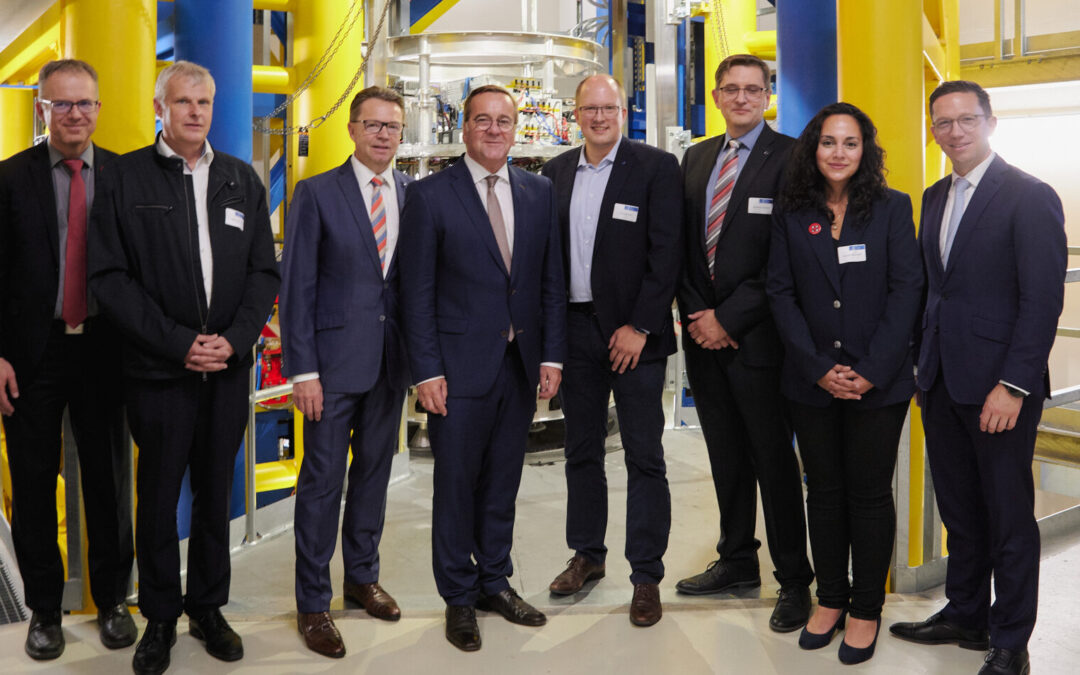
When local Member of Parliament and Germany’s Defense Minister, Boris Pistorius, visited the Quantum Valley Lower Saxony (QVLS), it wasn’t by coincidence. His visit reflects the growing importance of quantum research and technology for Germany’s future – not only in science, but also in innovation, industry, and even national security.
The reason to come here is clear: Hannover and Braunschweig have become a hotspot for quantum technologies. What sets this region apart is the combination of world-class research, advanced infrastructure, strong partnerships between academia and industry, and a vibrant network of physicists who are driving progress together.
Two Clusters of Excellence Extended
A centerpiece of the visit was the presentation of two Clusters of Excellence, both recently extended by the German Research Foundation (DFG). These clusters represent some of the most ambitious and forward-looking research efforts in Germany.
The first cluster, PhoenixD – Photonics, Optics, and Engineering Innovation Across Disciplines, is led by Prof. Uwe Morgner and Prof. Michael Kues. It is rethinking optical systems from the ground up. With the new Opticum campus, researchers and industry partners will share a single space, fostering collaboration.
The second cluster, QuantumFrontiers, was presented by Prof. Silke Ospelkaus, Prof. Michèle Heurs, and Prof. Stefanie Kroker. It pushes the boundaries of quantum metrology and precision measurement. From ultra-precise timekeeping to next-generation navigation and sensing technologies, their work will define key technologies of the future.
Infrastructure at the Cutting Edge
Beyond the clusters, the minister was introduced to unique research infrastructures that make Lower Saxony stand out.
At the Laser Zentrum Hannover (LZH), Prof. Dietmar Kracht presented advances in high-power laser research, which form a foundation for both scientific and industrial innovation.
At the Einstein Elevator, Dr. Christoph Lotz gave a tour of the world’s only rapid-drop tower that enables repeated experiments in microgravity conditions.
A critical challenge in quantum technology is transferring knowledge from the laboratory into practical applications. Prof. Christian Ospelkaus presented QVLS-iLabs, one of only seven initiatives nationwide funded as part of the BMBF’s Clusters4Future program. Its mission is to bridge the gap between academic research and industrial development, accelerating the creation of quantum hardware and applications.
During the visit, Dr. Celeste Torkzaban presented recent progress in ion-trap quantum computing, showcasing two calcium-ion qubits loaded onto a chip designed and fabricated entirely in Lower Saxony. This achievement shows that the region is not only contributing to global quantum science but is also capable of building sovereign quantum hardware – a strategic capability for Germany and Europe.
Strong Regional and Political Support
The visit also highlighted the ongoing support of Falko Mohrs, Lower Saxony’s Minister for Science and Culture, whose ministry has been instrumental in strengthening the region’s role in quantum research. With such support, the ecosystem has the momentum to continue growing as a hub of innovation.
Boris Pistorius’s visit underscored the strategic significance of QVLS. What has been built here is more than just a scientific cluster – it is an ecosystem where researchers, companies, and policymakers are shaping the technologies that will define the future.
With its clusters of excellence, unique infrastructures, dedicated researchers, and strong partnerships, Quantum Valley Lower Saxony has become a place worth visiting – and supporting.
Photos by Sören Pinsdorf, Leibniz University Hannover (LUH).