The clusters4future QVLS-iLabs enters its second phase with €15 million in funding
Thirteen quantum technology projects had been eagerly awaiting the decision — now the approval has been granted: the clusters4future QVLS-iLabs will receive an additional €15 million in funding from the German Federal Ministry for Research, Technology and Space (BMFTR). A further €8 million will be contributed from the cluster’s own resources. This brings the total funding available over the next three years to €23 million, aimed at advancing the development of application-oriented quantum components. The 25 partners of the future cluster — ranging from research institutions to industry and startups — share a common goal: accelerating the transfer of cutting-edge quantum technologies into the market.
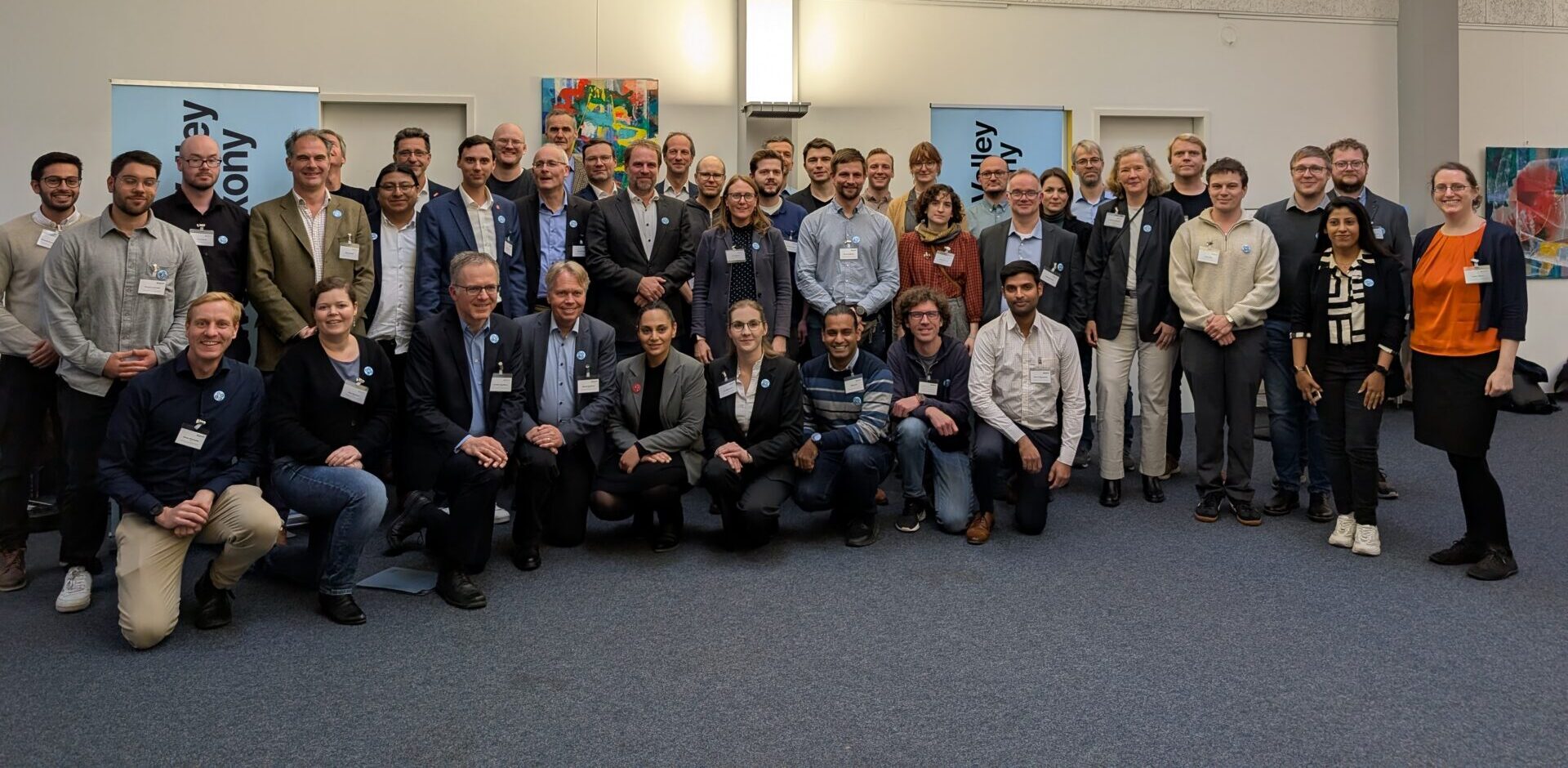
QVLS-iLabs cluster meeting in October 2025 © PTB
The fact that the Clusters4Future funding from the BMFTR is awarded to the Hannover–Braunschweig region is no coincidence. Under the umbrella of QVLS – Quantum Valley Lower Saxony, outstanding research institutions have come together: the Physikalisch-Technische Bundesanstalt, Technische Universität Braunschweig, Leibniz Universität Hannover, and the German Aerospace Center (DLR) with its Institute of Satellite Geodesy and Inertial Sensing. In collaboration with 21 companies, all participating experts are able to focus on their core strengths: quantum computing with trapped ions and novel applications of quantum metrology. The goal is to make everything smaller, better, and more stable. While the foundations for this were laid during the first funding phase, the second phase now becomes more concrete. For the industrial partners, this marks a major step toward turning future technology into practical everyday tools.
- This benefits not only the region but also generates value far beyond it, as initial results demonstrate:
Within the cluster, software for controlling quantum experiments was developed and released under an open-source license and is now used by research groups worldwide. - A project on more efficient battery production shows how quantum technologies can have a concrete impact: using novel quantum sensors, battery manufacturing processes are analyzed in detail — an important step toward more powerful and sustainable electromobility.
- In addition to numerous scientific publications, six new patents and invention disclosures document successful technology transfer, including improved atom sources and stable optical solutions for quantum chips, making the results usable for companies and international partners beyond QVLS-iLabs.
The success is spreading: WIKA Alexander Wiegand SE & Co. KG, Laseroptik GmbH, and Optomech GmbH have joined QVLS-iLabs as three new partners for the second phase.

In QVLS-iLabs, new designs of quantum-chips are developed. © PTB
Good for innovation, good for the region
Prof. Dr. Cornelia Denz, President of the Physikalisch-Technische Bundesanstalt:
“New quantum technologies with market-ready applications are within reach. It is therefore wonderful that the success story of this innovation ecosystem can be continued. I warmly congratulate all partners of the clusters4future QVLS-iLabs on being selected for further funding by the Federal Ministry of Research, Technology and Space (BMFTR). This is excellent news for the participating research institutions, the quantum industry, and startups — and for the entire region of the quantum cluster. Ultimately, society as a whole will benefit, as its future will be strongly shaped by technologically sovereign quantum technologies.”
Prof. Dr. Angela Ittel, President of Technische Universität Braunschweig:
“We see this as a true flagship of our region and a milestone for the future of Germany: it is about cutting-edge technology, quantum science, and outstanding collaboration. Together, the QuantumFrontiers Cluster of Excellence, Quantum Valley Lower Saxony, and the Nitride Technology Center are working on major innovations for humanity, such as the quantum computer. The performance of TU Braunschweig’s researchers is exceptionally strong — and it keeps society in mind. This is where bridges are built between quantum physics and application in society. This spirit also defines the Hightech Agenda Germany: thinking boldly, moving faster, and implementing consistently.”
Prof. Dr. Christian Ospelkaus, Speaker of QVLS-iLabs
(Physikalisch-Technische Bundesanstalt, Leibniz Universität Hannover):
“Our successes to date give us strong momentum for the next three years. Together with our industry partners, we are accelerating the transfer of quantum technologies into real-world applications and creating sustainable transfer structures for the path to market.”
Innovation ecosystem with its own deep-tech labs
The QVLS-iLabs is a regional innovation network — and this vision also has a physical home. In the cluster’s own deep-tech lab, covering 350 square meters in the Rollei Works in Braunschweig, quantum startups can take their first steps — and write success stories. One example is the Braunschweig-based quantum computer developed by QUDORA Technologies GmbH, which computes more efficiently than competing systems from Google and IBM. Additional support is provided by the newly founded QVLS Innovation GmbH, which will professionally manage the cluster, operate the deep-tech labs in the Rollei Works, and drive further quantum technology transfer projects in the region.
(Photo credit: © PTB)