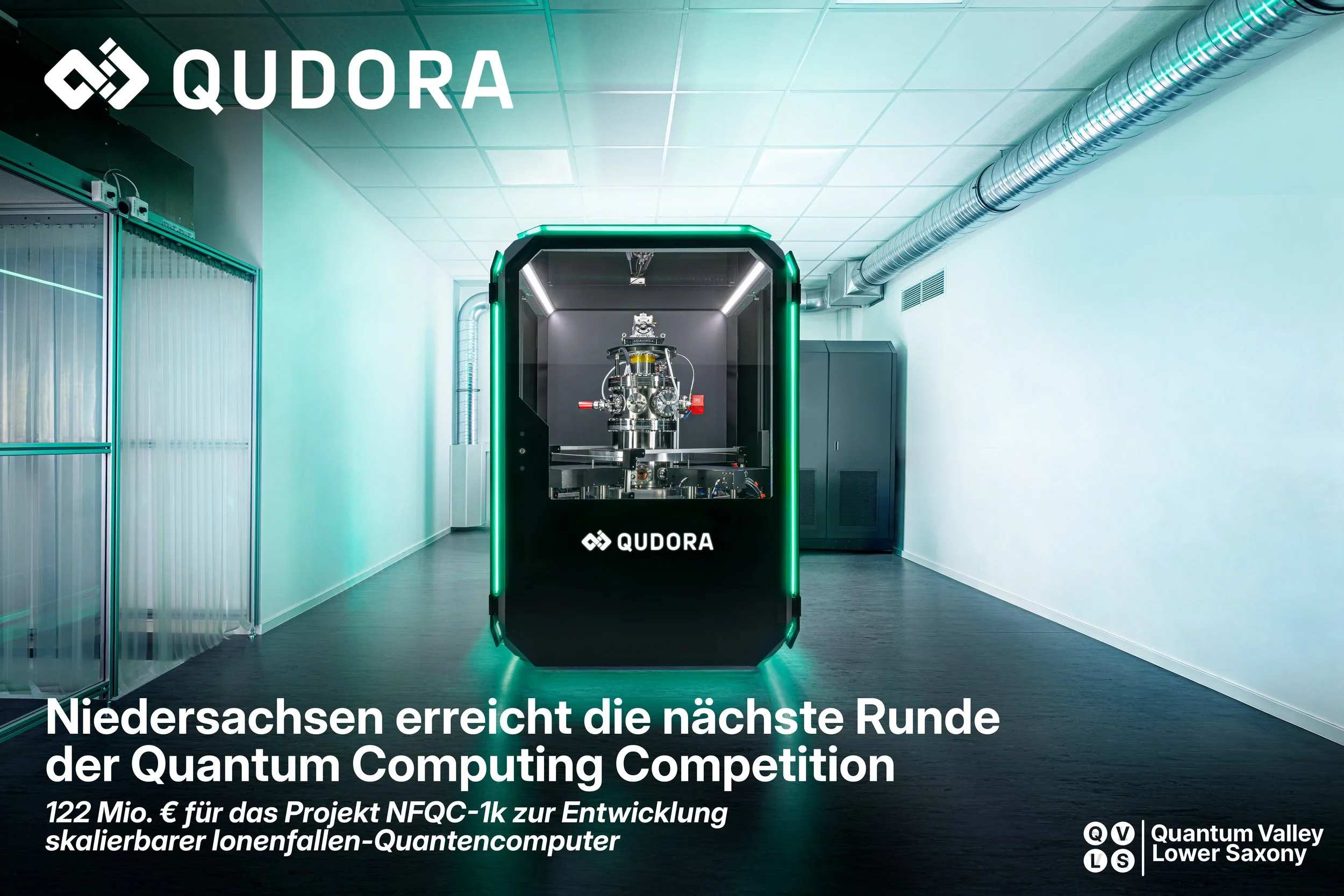
Lower Saxony Reaches Next Round of the Quantum Computing Competition
Consortium led by Lower Saxony spin-off QUDORA invited to submit full proposal
Hannover/Braunschweig, [23.09.2026] – QUDORA Technologies, a Lower Saxony spin-off of the Quantum Valley Lower Saxony, and its consortium have reached the next stage of the Quantum Computing Competition launched by the German Federal Ministry of Research, Technology and Space (BMFTR). Following a successful evaluation of the project outline, the consortium has been invited to submit a full proposal for the NFQC-1k project.
The project focuses on the development of scalable quantum computers based on trapped-ion technology – a technology that has been strategically developed in Lower Saxony over many years. The project now invited to submit a full proposal has a total volume of approximately €122 million, distributed among all seven consortium partners. The scientific and technological foundations were developed in particular at Leibniz University Hannover (LUH), Technische Universität Braunschweig (TUBS) and Physikalisch-Technische Bundesanstalt (PTB), and brought together within the Quantum Valley Lower Saxony (QVLS).
A major milestone was the QVLS-Q1 project, launched in 2021 to develop a 50-qubit trapped-ion quantum computer. The project received approximately €25 million in funding from the Lower Saxony Ministry of Science and Culture (MWK) and the Volkswagen Foundation. The subsequent BRIQ project continued the development of the technology platform. This established an early and sustained investment in Lower Saxony’s own trapped-ion technology – from fundamental research and technological scaling through to technology transfer and commercialization.
QUDORA emerged from this ecosystem. Today, the company leads the consortium’s industrial activities. In addition to the Lower Saxony partners, the consortium includes Forschungszentrum Jülich, NXP Semiconductors and AQT Deutschland GmbH. QUDORA is active in national and European projects and has expanded its international presence, including through a location in Japan.
The Quantum Computing Competition is part of Germany’s High-Tech Agenda. Quantum computing is among the strategic key technologies identified within this framework. In the international race for quantum computing, the focus is shifting beyond the performance of individual qubits to areas including scalability, error correction and industrial value chains. Key hardware platforms include trapped ions, neutral atoms and superconducting quantum circuits.
The invitation to submit a full proposal therefore also demonstrates the development of Lower Saxony’s quantum ecosystem: from long-term investment in cutting-edge research and the development of dedicated technology platforms to spin-offs and, ultimately, industrial and international scaling.
Voices from Lower Saxony
Falko Mohrs, Lower Saxony Minister for Science and Culture:
“It is excellent news that QVLS has reached the next round of the Quantum Computing Competition. Lower Saxony is playing in the premier league of quantum technology and is one of the leading locations in Germany and Europe. Our long-term investment in building the Quantum Valley Lower Saxony is paying off. With QUDORA, our universities, the Physikalisch-Technische Bundesanstalt and strong partners from science and industry, we are ideally positioned to play a central role in the development of fault-tolerant quantum computers. Together with the federal government, we want to use this head start to accelerate the transition of quantum technologies into real-world applications and create technological innovation, economic value and highly qualified jobs in Lower Saxony.”
QUDORA Technologies
“Quantum computing is now entering a phase in which it will become clear which technologies can make the transition from scientific excellence to industrially scalable systems. QUDORA has consistently advanced its trapped-ion technology and established itself in demanding national, European and international projects. The invitation to submit a full proposal is an important next step for us in demonstrating together with our partners that a technology developed in Lower Saxony can compete successfully in the international deep-tech landscape.”
Prof. Dr. Volker Epping, President of Leibniz University Hannover
“Quantum computing is a prime example of how long-term cutting-edge research can lead to technological innovation and successful technology transfer.”
Prof. Dr. Angela Ittel, President of Technische Universität Braunschweig
“Together with our partners in QVLS, we have succeeded in establishing Lower Saxony as an internationally outstanding quantum computing location. Researchers at the Nitride Technology Center (NTC), among others, have made important contributions to laying the foundations for this development. We are now excellently positioned to take the next steps in scaling the quantum computer being developed in Lower Saxony.”
Prof. Dr. Cornelia Denz, President of Physikalisch-Technische Bundesanstalt
“Scalable quantum computers require the highest levels of precision and reproducible technologies – this is precisely where PTB contributes its particular expertise.”
Quantum Valley Lower Saxony
“From cutting-edge research to industrial scaling: this achievement highlights the strength of Lower Saxony’s quantum ecosystem.”